The 20” wheel is standard on the F-150 Lightning Lariat and Flash trims and available as an upgrade on the XLT. It ships with a Hankook Dynapro AT2 in 275/60R20. For 18” Pro and XLT wheels see the 18” guide. For 22” Platinum wheels see the 22” guide.
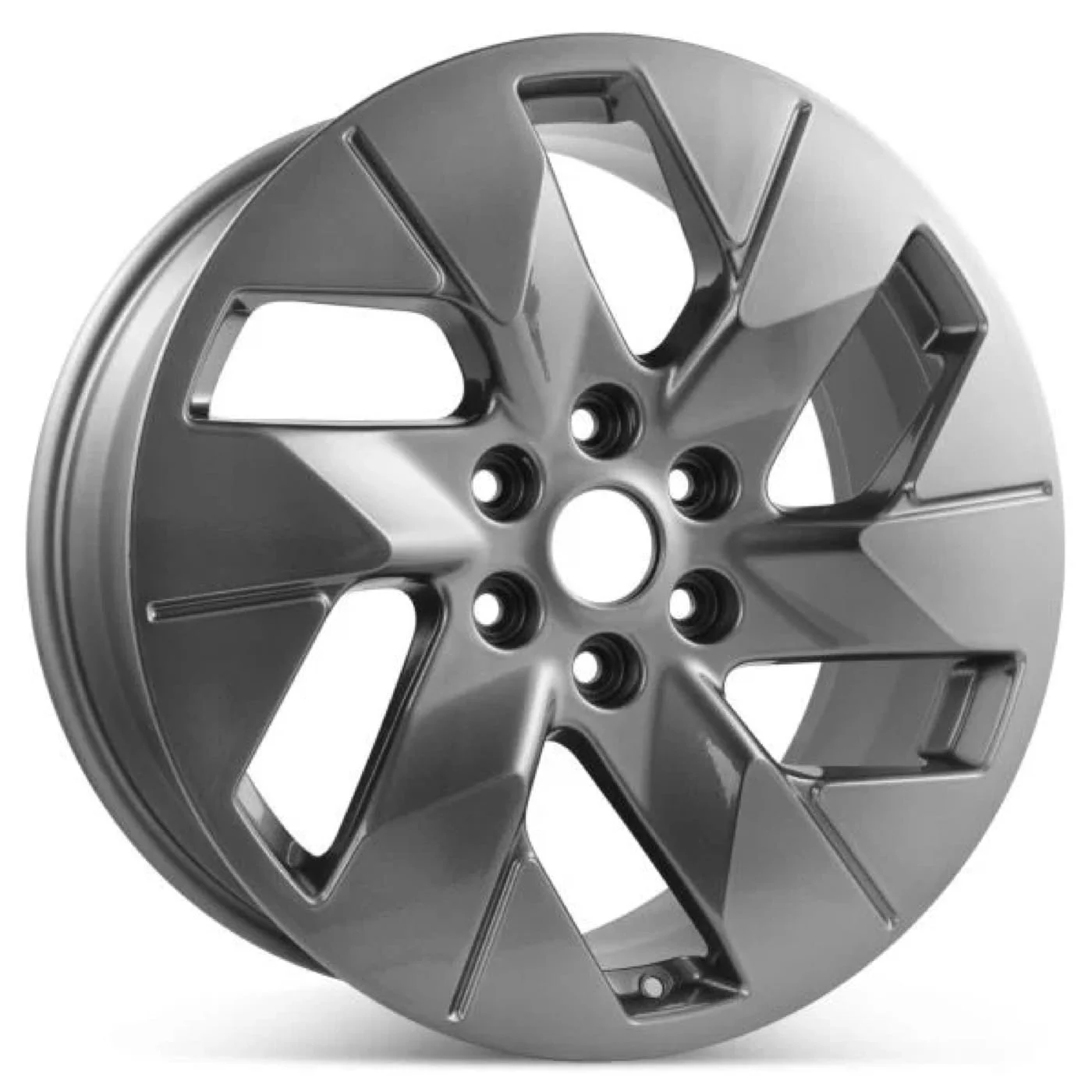
OEM Wheel and Tire Specs
| Spec | Value |
|---|---|
| Wheel size | 20×8.5” |
| Offset (ET) | +44 |
| Bolt pattern | 6×135 |
| Centerbore | 87.1mm |
| Tire Model | Load/Speed | Category | Notes |
|---|---|---|---|
| Hankook Dynapro AT2 | 115T SL | On-Road All-Terrain | |
| Goodyear Wrangler Territory HT | 115H SL | Highway All-Season | |
| General Grabber HTS 60 | 116T XL | Highway All-Season |
The three-way split across the 20-inch lineup reflects Ford’s attempt to serve three distinct buyer profiles with a single wheel diameter. The Hankook Dynapro AT2 is the primary factory standard tire. It is an On-Road A/T with independent tread blocks and step-block structures that give the dual-motor drivetrain’s 775 lb-ft of instant torque something to bite into on gravel, light mud, and job sites, at a modest rolling-resistance penalty. Ford does not allow buyers to specify a tire brand at order time. Like many manufacturers, Ford utilizes supply chain dual-sourcing and which tire your truck ships with depends on trim spec, battery configuration, and factory supply allocation at the time your truck was built.
The F-150 Lightning delivers full torque output from a stop. Combined with the independent rear suspension layout, this accelerates inner and center tread wear on rear axle tires compared to a traditional ICE truck. Strict 5,000-mile tire rotation intervals are strongly recommended.
Before You Buy
Tire size. The OEM size is 275/60R20. This is a widely stocked truck size. 285/60R20 is a fitment-friendly alternative with a solid selection of All-Terrain tires. It is 10mm wider and 1.4% taller, well within the rule of thumb ±3% of factory overall diameter.
Load index. The factory tire options span both SL and XL ratings: the Hankook Dynapro AT2 and Goodyear Wrangler Territory HT are Standard Load (SL) at index 115 (2,679 lbs per tire) while the General Grabber HTS 60 is Extra Load (XL) at index 116 (2,756 lbs per tire). Ford’s use of SL tires reflects certification minimums and rolling resistance targets, not a ceiling on what the truck needs. At up to 6,893 lbs curb weight before payload, XL-rated replacements are the preferred choice. XL tires carry more load at higher inflation pressures and provide better margin against the dynamic stresses of instant electric torque delivery. SL tires at index 115 or higher are acceptable if XL is not available in your chosen model. Do not fit tires with a load index below 115.
TPMS. The F-150 Lightning uses direct TPMS sensors operating at 315 MHz, integrated into the valve stems. The sensor stays in the wheel during a tire swap — you do not need new sensors on a standard replacement. A valve stem seal inspection is normal. Retraining is required after any tire change. With the vehicle off, cycle the ignition to the ON position (engine off). Press the hazard light button 3 times (or 6 times on some firmware versions). The horn will honk once to confirm training mode is active. Starting at the front-left tire, use a Ford TPMS activation tool or bleed air continuously from the valve stem until the horn honks. Repeat clockwise: front-right, rear-right, rear-left.
Spare tire. The F-150 Lightning includes a full-size matching spare tire and wheel mounted beneath the truck bed. The factory mechanical jack and lug wrench are stored under the rear passenger seating.
AWD tread depth tolerance. The dual-motor AWD drivetrain requires tires within 2/32”–3/32” of tread depth across all four wheels. Mismatched depths stress the electronic differentials. When replacing fewer than four tires, match tread depth closely across axles.
Replacing in pairs. Replace tires in axle pairs. When replacing two tires, mount the newer tires with more tread on the rear axle.
On-Road All-Terrain
The Hankook Dynapro AT2 falls in the On-Road All-Terrain category. These tires prioritize pavement manners and noise over maximum off-road capability. If your Lightning sees mostly pavement and occasional light gravel, this category offers a quieter, longer-wearing alternative to more aggressive off-road tiers while retaining a capable tread design.
| Tire | Price / Tire | |
|---|---|---|
Original Size275/60R20 | ||
| Bridgestone Dueler A/T Ascent275/60R20 | $309.99Tire Rack → | |
| Cooper Discoverer Road+Trail AT275/60R20 | $301.99Tire Rack → | |
| Nitto Nomad Grappler275/60R20 | $262.00Tire Rack → | |
| Vredestein Pinza AT275/60R20 | $284.77Tire Rack → | |
| Yokohama Geolandar A/T4275/60R20 | $296.99Tire Rack → | |
| Hankook Dynapro AT2 (OEM) 275/60R20 | $338.99Tire Rack → | |
Alternative Size285/60R20 | ||
| Bridgestone Dueler A/T AscentLT285/60R20 | Check PriceTire Rack → | |
| Yokohama Geolandar A/T4LT285/60R20 | Check PriceTire Rack → | |
Price availability updated September 2026. Actual prices may vary.
Off-Road All-Terrain
Off-Road All-Terrain tires have more aggressive block patterns and larger void ratios that deliver real mud and rock capability at the cost of more road noise and modestly higher rolling resistance. These are the choice when the off-road use is actual trail driving, loaded overlanding, or regular unpaved miles rather than the occasional gravel driveway. The BFGoodrich All-Terrain T/A KO series has been the dominant recommendation for over a decade. It is not the quietest or most fuel-efficient, and the KO3 is notoriously hard to balance, but it is exceptionally durable and holds up to abuse that would damage lesser tires. The Falken Wildpeak AT4W is the primary alternative at a lower price, with slightly better on-pavement manners and comparable trail performance for most use cases.
| Tire | Price / Tire | |
|---|---|---|
Original Size275/60R20 | ||
| BFGoodrich All-Terrain T/A KO3LT275/60R20 | $344.99Tire Rack → | |
| Falken WildPeak A/T4W275/60R20 | $342.00Tire Rack → | |
| General Grabber A/TX275/60R20 | $320.99Tire Rack → | |
| Goodyear Wrangler Workhorse AT2275/60R20 | $293.99Tire Rack → | |
| Toyo Open Country A/T III275/60R20 | $385.76Tire Rack → | |
| Toyo Open Country A/T III EV275/60R20 | $412.03Tire Rack → | |
Alternative Size285/60R20 | ||
| BFGoodrich All-Terrain T/A KO3LT285/60R20 | Check PriceTire Rack → | |
| Falken WildPeak A/T4WLT285/60R20 | Check PriceTire Rack → | |
| General Grabber A/TXLT285/60R20 | Check PriceTire Rack → | |
| Goodyear Wrangler Workhorse AT2LT285/60R20 | Check PriceTire Rack → | |
| Toyo Open Country A/T III285/60R20 | $393.09Tire Rack → | |
Price availability updated September 2026. Actual prices may vary.
Highway All-Season
Highway All-Season tires trade all-terrain tread structure for lower rolling resistance, quieter road noise, and longer tread life. Best suited for Lightning owners whose truck stays on pavement and who want to maximize range efficiency.
| Tire | Price / Tire | |
|---|---|---|
Original Size275/60R20 | ||
| Bridgestone Dueler LX275/60R20 | $272.00Tire Rack → | |
| Continental TerrainContact HT275/60R20 | $276.99Tire Rack → | |
| General Grabber HTS 60 (OEM) 275/60R20 | $221.66Tire Rack → | |
| Goodyear Wrangler Steadfast HT275/60R20 | $299.99Tire Rack → | |
| Goodyear Wrangler Territory HT (OEM) 275/60R20 | $267.99Tire Rack → | |
| Michelin Defender LTX M/S2275/60R20 | $322.99Tire Rack → | |
Alternative Size285/60R20 | ||
| Continental TerrainContact HTLT285/60R20 | Check PriceTire Rack → | |
Price availability updated September 2026. Actual prices may vary.
Winter
The F-150 Lightning’s dual-motor AWD provides meaningful traction advantage in mixed winter conditions. For regions with serious ice and packed snow, a dedicated winter tire is still the correct answer — no all-terrain compound matches a proper winter compound below freezing. A seasonal swap on a separate set of 20” wheels is the most economical approach.
The most readily available winter tire category in pickup sizes is Studless Ice and Snow — tires that deliver maximum grip in severe winter conditions using advanced siping and compounds that remain pliable in extreme cold. Best for regions with long, harsh winters where maximum grip outweighs other concerns.
| Tire | Price / Tire |
|---|---|
| Bridgestone Blizzak IcePeak275/60R20Studless Ice & Snow | $311.34Tire Rack → |
| Michelin X-Ice Snow SUV275/60R20Studless Ice & Snow | $285.07Tire Rack → |
| Nokian Hakkapeliitta R5 SUV275/60R20Studless Ice & Snow | $351.55Tire Rack → |
Price availability updated September 2026. Actual prices may vary.
Mounting and Installation
A few reminders specific to the F-150 Lightning:
- TPMS sensors stay in the wheel. The 315 MHz direct TPMS sensors are integrated into the valve stems and are not disturbed during a tire swap. Do not pay for new sensors on a standard replacement. A valve stem seal inspection or replacement is normal.
- TPMS retraining procedure. With the vehicle off, cycle the ignition to the ON position (engine off). Press the hazard light button 3 times (or 6 times on some firmware versions). The horn will honk once to confirm training mode is active. Starting at the front-left tire, use a Ford TPMS activation tool or bleed air continuously from the valve stem until the horn honks. Repeat clockwise: front-right, rear-right, rear-left.
- Lug nut torque spec: 150 lb-ft (204 Nm). Confirm your installer has properly torqued all lug nuts to spec with a calibrated torque wrench. Lug thread size is M14×1.5.
- Full-size spare included. The spare tire and wheel are mounted beneath the truck bed. The factory jack and lug wrench are stored under the rear passenger seating.
- AWD tread depth tolerance. Keep tread depth within 2/32”–3/32” across all four wheels to avoid stressing the dual-motor drivetrain differentials.
- New tires go on the rear. When replacing fewer than four tires, mount the tires with the most tread on the rear axle.