The BMW E9X M3 is the fourth generation of BMW’s M3 lineage, produced globally from 2007 to 2013 and sold in North America from 2008 to 2013. It was offered in three body styles: the E90 Sedan, the E92 Coupe, and the E93 Convertible. All three share the same high-revving 414 hp, 8,400 rpm redline, S65B40 4.0L naturally aspirated V8, factory flared fenders, and upgraded suspension.
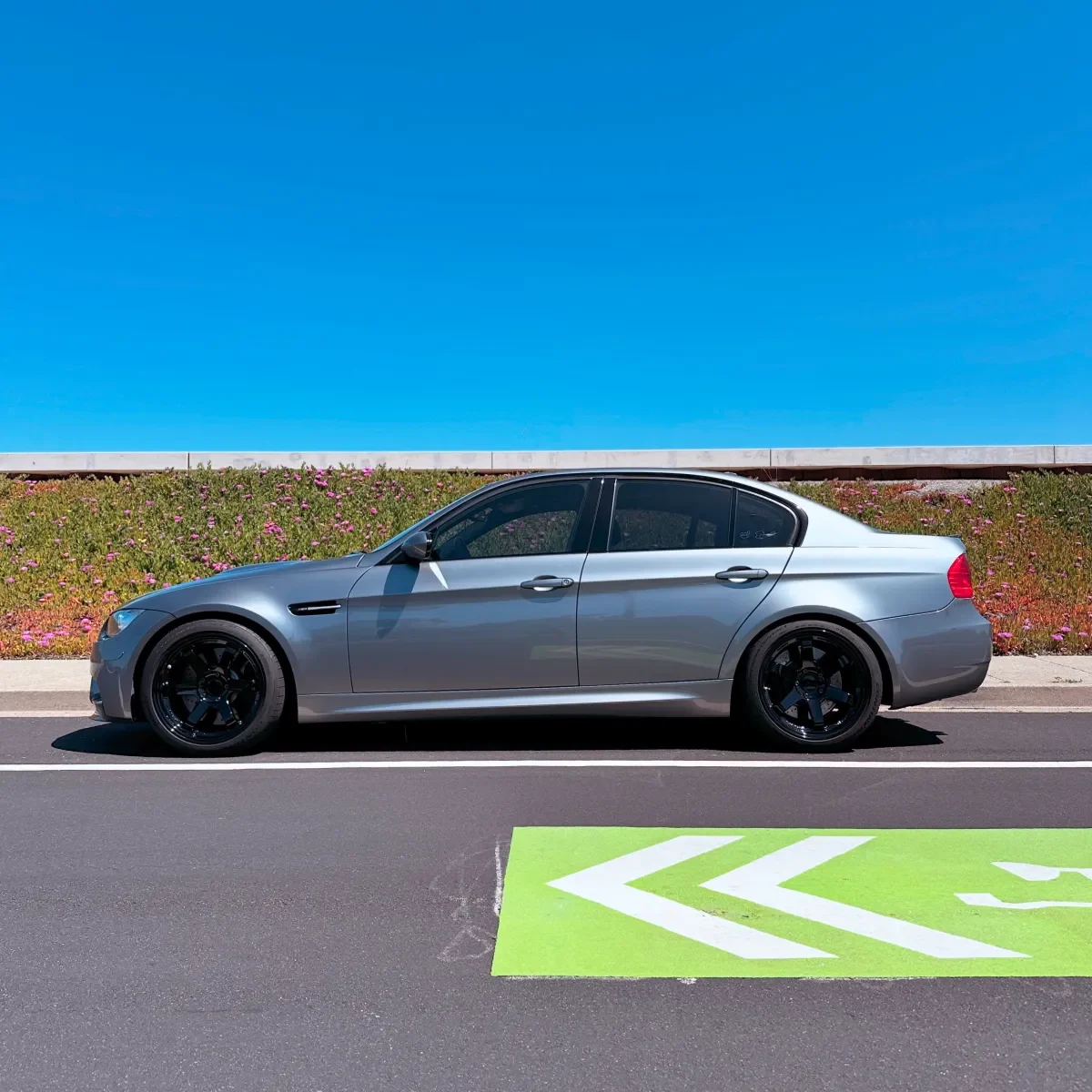
The factory arrived with a meaningfully wider wheel package than its E46 predecessor and the non-M E9X. This gives the E9X M3 more room to grow without body modification compared to earlier generations or even the base model E9Xs, and it shows in what the platform can accommodate as a direct bolt-on.
Platform Note: The E90M Sedan, E92M Coupe, and E93M Convertible share identical hub architecture, bolt patterns, factory wheel packages, and rear suspension track width. Fitment guidance in this document applies to all three body styles unless explicitly noted.
For compatible tire sizes and diameter tolerance requirements, see the E9X M3 Tire Guide. For quick-reference wheel and tire combinations, consult the E9X M3 Wheel and Tire Cheatsheet.
OEM / Stock Wheel Specifications
All E9X M3 variants share identical hub architecture.
| Bolt Pattern | 5×120 |
| Centerbore | 72.6mm |
| Thread Pitch | M12×1.5 |
| Lug Torque | 88 lb-ft (120 Nm) |
| Lug Seat | 60° conical |
BMW uses bolts, not studs. The 60-degree conical seat of the bolt locates the wheel against the hub. Spherical-seat hardware will not correctly load the wheel. Torque in a star pattern and torque cold. The E9X M3’s M12×1.5 thread pitch is sometimes a source of confusion for owners transitioning from or to other generations. Later F-series and G-series M3 and M4 models use M14×1.25 bolts. Over-torquing M12 bolts to the M14 spec of 120 lb-ft can stretch threads or damage aluminum hubs.
Factory Wheel Packages
| Package | Wheels | Tires |
|---|---|---|
| 18" Style 219M Standard base equipment, Cast (NA) | 18x8.5” +29 F 18x9.5” +23 R | 245/40ZR18 F 265/40ZR18 R |
| 18" Style 260M Standard base equipment, Cast (EU) | 18x8.5” +29 F 18x9.5” +23 R | 245/40ZR18 F 265/40ZR18 R |
| 19" Style 220M Optional Upgrade, Forged | 19x8.5” +29 F 19x9.5” +23 R | 245/35ZR19 F 265/35ZR19 R |
| 19" Style 359M ZCP Competition Package (ZCP) and GTS, Cast | 19x9.0” +31 F 19x10.0” +25 R | 245/35ZR19 F 265/35ZR19 R * Limited Edition GTS ran 255/35R19 F / 285/30R19 R from the factory. |
The ZCP Competition Package’s Style 359M represents a step up from the standard stagger: a half-inch wider front and rear, while retaining relatively aggressive offsets for a factory car. Interestingly, the optional Style 220M wheels are forged rather than cast, reducing unsprung weight at 23.1 lbs front and 24.4 lbs rear, besting the Competition Package’s cast 359M at 26.0 lbs front and 26.8 lbs rear, but with a narrower track width. The same 245/35ZR19 front and 265/35ZR19 rear tires are used on both the optional Style 220M and the ZCP Style 359M, despite the wider ZCP wheels. The limited edition GTS featured 255/35ZR19 front and 285/30ZR19 rear on the 359Ms, useful context for owners exploring wider tire options. See the E9X M3 Tire Guide for more tire choices and stagger data.
Aftermarket Considerations
Square vs. Staggered
The factory stagger creates a fundamental tradeoff. Staggered setups (wider rear) maximize rear contact patch, which is ideal for an RWD car under acceleration, but eliminate the ability to rotate tires front-to-rear, accelerating wear costs. Square setups allow full rotation, which is particularly valuable for track-driven cars that consume rear tires quickly.
The choice has a less obvious consequence on this platform: it directly affects how the Dynamic Stability Control (DSC) and M Dynamic Mode (MDM) systems behave.
DSC and Rotational Baseline
The E9X M3’s DSC monitors individual wheel speed sensors continuously to calculate slip levels and coordinate stability interventions. It uses the front-to-rear axle speed ratio as a baseline — if the rear wheels accelerate faster than expected relative to the fronts, the system interprets that as traction loss.
Under the factory stagger (e.g., 245/40R18 front, 265/40R18 rear), the larger rear tire has an overall diameter approximately 2.4% greater than the front. This means the rear wheels naturally rotate slower at any given vehicle speed. The DSC is calibrated to treat this ratio as its zero-slip reference point.
Square setups: Running identical tire heights on both axles brings the axle speed ratio to 0%. On initial installation, the DSC still expects the rear wheels to turn 2.4% slower, so identical front and rear speeds register as mild rear-axle acceleration. This can produce premature DSC or MDM interventions manifesting as throttle cuts or wheel braking during hard straight-line acceleration or cornering, even with full mechanical grip available. Fortunately, the system is adaptive. It requires approximately 60–70 miles of predominantly straight-line driving to recalibrate to the new rotational constant. Once learned, false intervention frequency returns to normal thresholds.
Exaggerated stagger: Moving to a significantly taller rear tire than the factory spec increases the axle speed differential beyond the calibrated baseline. The DSC interprets the slower-spinning rear wheels as being further from slip than they actually are, which can delay necessary stability interventions. This is a less commonly discussed risk of running a different setup than stock.
Front Suspension Clearance
The E9X M3 front uses a MacPherson strut arrangement. On the factory dampers, inner clearance between the tire sidewall and the spring perch accommodates the OEM 245/40R18 tire on the standard 18x8.5” +29 wheel without issue.
When aftermarket coilovers are installed, the change in position of the spring perch can change this equation. Inner barrel clearance is determined by the combination of wheel width and offset. A wider wheel or a higher offset both push the inner barrel further inboard toward the strut. On some aftermarket coilovers, front wheels wider than 9.0” at offsets of +25mm or greater can make contact with the spring perch or spring, requiring spacers or a different fitment to resolve. This is especially true for adjustable spring perch type “coilovers” on OE struts and those with progressive street-focused springs, rather than linear race springs. The OEM 8.5” +29 front sits well within safe territory on the factory dampers, but coilover owners stepping up to 9.0” or 9.5” front wheels should verify inner barrel clearance against their specific spring perch design before committing to an offset. Typically a 5mm spacer will suffice if using the widths and offsets noted in this guide.
For more aggressive setups, pulling the factory alignment pins on the upper strut mounts increases available front negative camber to approximately -1.3° to -1.5°. This moves the tire shoulder slightly away from the inner fender at the top of travel. It is a common and fully reversible modification requiring no additional hardware. More negative camber will require upper camber plates.
Rear Fender Clearance
Rear outer fender lip clearance is determined by the combination of wheel width, offset, and tire width. A 10.5” wide rear wheel at +22mm with 295mm tires reaches the fender lip at a more modest drop. Adding additional camber in the rear or rolling the rear fenders is a prerequisite for more aggressive rear fitments.
All three body styles have equivalent rear fitment clearance. The E90 Sedan’s rear fender flares appear more dramatic than the E92 and E93 as a visual consequence of the sedan body being narrower, requiring a more abrupt flare to cover the same wide suspension track. The underlying clearance envelope is identical across all three variants.
Another commonly repeated misconception: non-M LCI E90 sedans received an 8mm wider rear track width during the 2009 production facelift. LCI (Life Cycle Impulse) is BMW’s term for a mid-cycle refresh. The E9X M3 received its LCI update for the 2010 model year (build dates from 09/2009). The E90 M3 LCI did not receive the track width change applied to the standard E90 sedan. Pre-LCI and LCI E90 M3 rear suspension track widths and offset clearances are identical.
Direct TPMS — Pre-LCI and LCI Protocol Split
The E9X M3 uses direct TPMS which are battery-powered pressure sensors mounted inside each wheel operating at 433 MHz that transmit live pressure data to the vehicle’s RDC receiver module.
BMW changed the sensor communication protocol in September 2009 for the MY2010 production cycle.
- Pre-LCI (MY2009 build dates up to 08/2009): Gen-1 HUF/Beru pre-LCI protocol
- LCI (MY2010 build dates from 09/2009 onward): Gen-2 HUF LCI protocol
These sensor generations are not interchangeable. Sensors from a pre-LCI set installed in an LCI vehicle will fail to pair with the RDC module, and vice versa. When purchasing a used set of E9X M3 wheels, verify that the sensor generation matches your vehicle’s build date before assuming the TPMS will function.
Aftermarket universal sensors can be programmed to either protocol using a TPMS programming tool and are a practical solution when the OEM sensors are missing or have failed. See the E9X M3 Tire Guide for the full TPMS recalibration procedure after pressure adjustments or wheel swaps.
Hub Centricity
The M3’s 72.6mm centerbore requires hub-centric fitment. Aftermarket 5×120 wheels frequently come with 72.56mm or 74.1mm bores. Precision-machined aluminum hub-centric rings must be used for any bore larger than 72.6mm to prevent vibration and shear loading on the bolts under dynamic conditions. Plastic rings are not recommended for track use as brake heat can melt them, complicating wheel removal and potentially leaving debris in the hub.
Wheel Load Ratings
The E92 M3 Coupe weighs approximately 3,704 lbs and the E90 M3 Sedan approximately 3,725 lbs. Dynamic cornering and braking loads multiply static weight significantly. When selecting aftermarket wheels, the load rating is a critical safety specification. Wheels are typically rated in kilograms per wheel, with the rating stamped on the back of the wheel barrel or documented in the manufacturer’s specifications.
The E9X M3’s gross axle weight ratings are approximately 1,020 kg (2,248 lbs) front and 1,150 kg (2,535 lbs) rear. Dividing the highest axle rating by each corner and adjusting for dynamic loads gives a minimum wheel load rating of 690 kg (1,520 lbs) per wheel as the starting point for street use. Track use, particularly at venues involving curbing, should target 750 kg (1,650 lbs) or higher. Always verify load ratings with the manufacturer before purchasing. If a manufacturer cannot provide this data, look for different wheels.
M Differential Rear Tread Sensitivity
The Variable M Differential Lock uses a speed-sensing, clutch-based mechanism. Rear tires with more than 2/32” (1.6mm) of tread depth variance across the axle create uneven strain on the differential clutch plates, accelerating wear. On a staggered setup where front-to-rear rotation is not possible, it is critical to monitor rear tire depths and replace both rear tires together when they approach their limits.
Wheel Recommendations
The recommendations below are based on research data, community fitment reports, and platform-specific limitations. Actual fitment depends on your specific wheel’s spoke profile and barrel shape, suspension, ride height, and alignment. Always verify fitment for your specific combination before purchasing.
All offsets listed are wheel offsets. Where spacers are part of a recommended setup they are called out explicitly. A wheel at ET30 with a 5mm spacer achieves the same outboard position as an ET25 wheel. See the Spacers & Adapters Guide for more.
OEM+ Recommendations
Conservative sizes close to factory specifications. These clear stock brakes, require no fender massaging, and work on factory suspension.
| Setup | Notes |
|---|---|
18x9” +25-30 F | Staggered OEM+. Matches ZCP wheel widths and stance or expands track width modestly. Pair with factory tire sizes which are at the limit of the recommended width or 255/35R18 F / 275/35R18 R and 265/35R18 F / 285/35R18 R combinations for a wider contact patch. |
| 18x9.5” +20-25 | Square setup allows full tire rotation. 10mm+ rear spacer for aesthetics. Pairs with 265/35R18 or 275/35R18. |
19x9” +25-30 F | Staggered OEM+. Matches ZCP wheel widths and stance or expands track width modestly. Pair with factory tire sizes or 255/35R19 F / 275/35R19 R and 265/30R19 F / 285/30R19 R combinations for a wider contact patch. |
Aggressive Street Recommendations
Flush or near-flush fitments that go wider than factory while requiring zero or minor modifications. These represent the enthusiast sweet spot for the E9X M3. The platform accommodates aggressive widths from the factory more readily than most.
| Setup | Notes |
|---|---|
18x9.5” +20-25 F | “Easy button”. Staggered flush street. Pairs with 265/35R18 F / 285/35R18 R. Fits at stock ride height without fender modifications. For front fitment, see note on Coilover Spring Perch Clearance. On lowered cars, additional rear negative camber (-1.8°) or light rear fender rolling may be needed. 275/35R18 F / 295/35R18 R may fit with more rear negative camber (-2.0°) and/or fender rolling depending on tire choice. |
| 18x10” +20-25 | Square performance street. Pairs with 275/35R18. Pull the factory alignment pins on the upper strut mounts to maximize front negative camber to approximately -1.3° to -1.5°. For front fitment, see note on Coilover Spring Perch Clearance. |
19x9.5” +22 F | 19-inch staggered flush street. Pairs with 265/30R19 F / 285/30R19 R. Fits at stock ride height without fender modifications. For front fitment, see note on Coilover Spring Perch Clearance. On lowered cars, additional rear negative camber (-1.8°) or light rear fender rolling may be needed. 275/30R19 F / 295/30R19 R may fit with more rear negative camber (-2.0°) and/or fender rolling depending on tire choice. |
Track / Competition Recommendations
Maximum contact patch configurations requiring dedicated alignment hardware and fender work. These setups extract the most from the chassis under sustained lateral load.
| Setup | Notes |
|---|---|
| 18x10.5” +20-25 | Track Square. Pairs with 285/35R18 or 295/30R18. Requires adjustable camber plates to achieve minimum of -2.5° to -3.0° front negative camber depending on tire choice and track-oriented coilovers for front inner clearance. Rears require aggressive camber and/or fender rolling depending on tire choice and ride height. |
18x10” +20-25 F | Track Staggered for maximum rear grip. 275/35R18 F / 295/35R18 R or a 305/35R18 rear. For front fitment, see note on Coilover Spring Perch Clearance. This is a very aggressive setup that may require fender pulling and removing rear fender liners. Use of spacers and precise alignment is required in rear to dial in fitment and is sensitive to tire choice and even tire pressures. |
Additional Resources
- Quick Reference: E9X M3 Wheel and Tire Cheatsheet for validated wheel and tire combinations
- Tire Compatibility: See the E9X M3 Tire Guide for diameter calculations, compatible tire sizes, and performance categories