The BMW E46 M3 represents the third generation of BMW’s M3 lineage and is widely regarded as one of the most complete analogue sports cars ever built. Produced from 2000 to 2006 globally (2001 to 2006 in North America), it was offered in Coupe and Convertible form, with a limited-production Coupe Sport Leichtbau (CSL, or Coupe Sport Lightweight for US audiences) sold exclusively in European and Japanese markets. All models share the same fundamental hub architecture, bolt pattern, and suspension geometry.
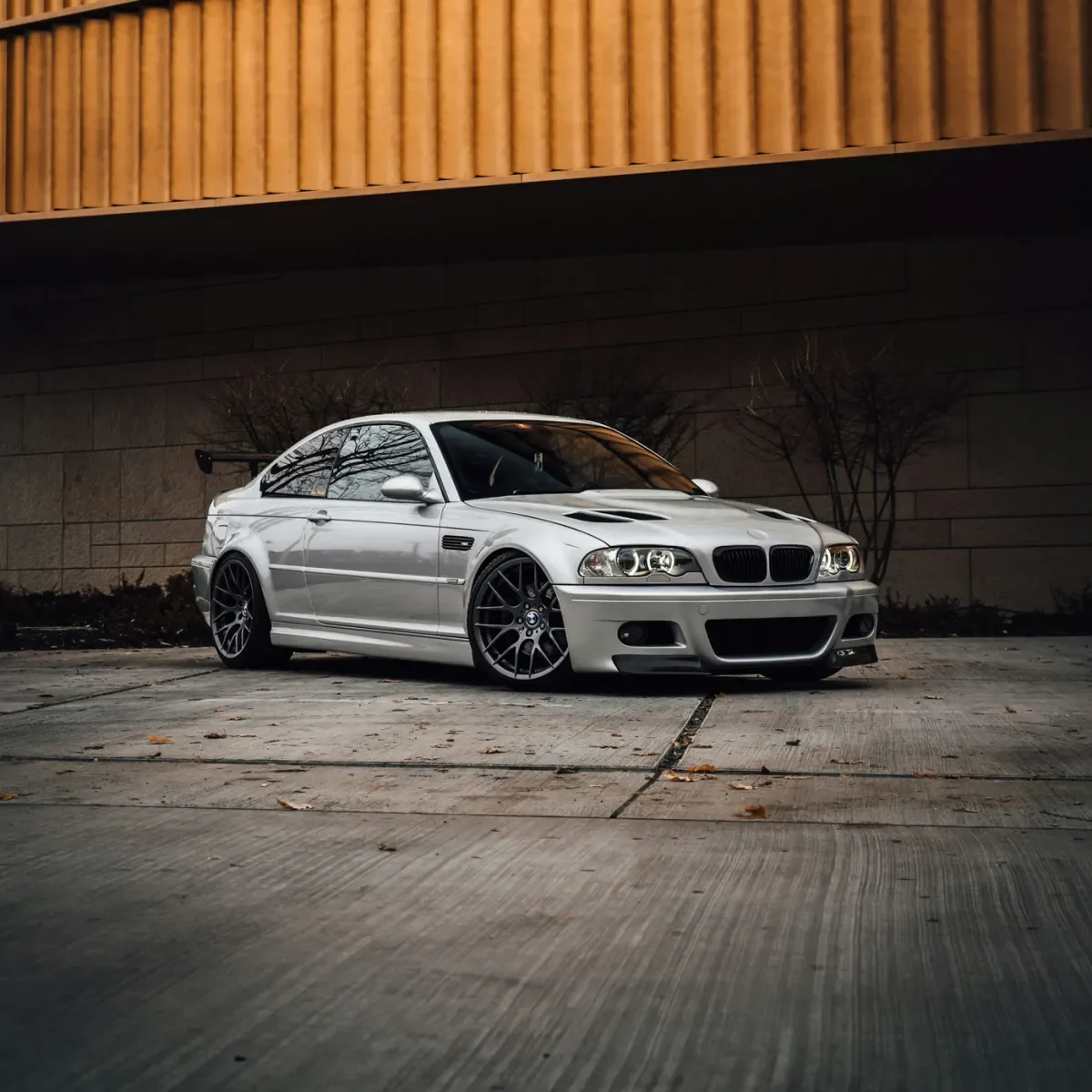
The sonorous S54 engine and chassis tuning receive most of the attention, but the wheel and tire package is an equally critical engineering decision on this platform. The factory ran a staggered configuration, deliberately widening the rear track for lateral stability while preserving the front scrub radius for steering feel. Understanding why these numbers exist is the foundation for any successful aftermarket wheel setup.
For compatible tire sizes, diameter tolerance requirements, and tire recommendations by category, see the E46 M3 Tire Guide. For quick-reference wheel and tire combinations, consult the E46 M3 Wheel and Tire Cheatsheet.
OEM / Stock Wheel Specifications
All E46 M3 variants share identical hub architecture.
| Bolt Pattern | 5×120 |
| Centerbore | 72.6mm |
| Thread Pitch | M12×1.5 |
| Lug Torque | 88 lb-ft (120 Nm) |
| Lug Seat | 60° conical |
BMW uses bolts, not studs. The conical seat of the bolt locates the wheel against the hub. Using wheel nuts with a spherical seat on conical-seat wheels (or vice versa) is a serious safety fault. Tighten in a star pattern and always torque cold. Thermal expansion during track sessions causes inaccurate readings.
Factory Wheel Packages
BMW offered three distinct factory wheel configurations on the E46 M3, all sharing the staggered offset philosophy:
| Package | Specs | Tire Sizes |
|---|---|---|
| 18" Style 67 Standard, Cast | 18x8” +47 F 18x9” +26 R | 225/45R18 F 255/40R18 R |
| 19" Style 67 Optional Upgrade, Forged Spokes | 19x8” +47 F 19x9.5” +27 R | 225/40R19 F 255/35R19 R |
| 19" Style 163M ZCP Competition Package (ZCP), BBS Flow-Formed | 19x8” +47 F 19x9.5” +27 | 225/40R19 F 255/35R19 R |
| 19" Style 163M CSL CSL (Euro/Japan only), BBS Flow-Formed | 19x8.5” +44 F 19x9.5” +27 | 225/40R19 F 255/35R19 R |
The CSL’s 8.5-inch wide front wheel with ET44 was engineered specifically to support wider front tires, mitigating the standard car’s mid-corner understeer tendency under threshold braking. It is the only factory package with a front wheel wider than 8.0 inches.
Aftermarket Considerations
Square vs. Staggered
The factory stagger creates an important tradeoff for aftermarket wheels and tires. Staggered setups (wider rear) maximize rear contact patch, which is ideal for a RWD car under acceleration, but eliminate the ability to rotate tires front-to-rear, accelerating wear costs. Square setups (same width all around) allow full tire rotation, dramatically lowering running costs, and also eliminate a subtle but meaningful DSC stability control sensitivity issue.
The E46 M3’s DSC (Dynamic Stability Control) system compares wheel speeds across axles to detect slip. The factory stagger was engineered to a 0.06-inch front-to-rear diameter delta. When an aftermarket staggered setup deviates significantly from this baseline, DSC can misinterpret the axle speed imbalance as wheel slip and trigger spurious traction control interventions. A square tire setup achieves a perfect 1:1 front-to-rear diameter ratio, eliminating this sensitivity entirely. For track use, where DSC is typically disabled, this is a moot point. For spirited street driving with DSC active, square setups have an incidental practical advantage.
Front Suspension Clearance
The front axle uses a MacPherson strut arrangement. On factory Sachs dampers, the inner clearance between the tire sidewall and the spring coil is sufficient for moderately wider setups. When aftermarket coilovers are installed this clearance can be severely reduced by the larger main spring diameter and the height-adjustment collars.
Running front wheels wider than 9.0 inches with offsets greater than +35 mm (ex: 18x9.5” ET35) can cause the tire sidewall to rub against the spring perch or lower collar under suspension travel. The standard solution is a 5 mm slip-on spacer to push the wheel assembly outboard. Some coilover manufacturers offer spindle spacer kits that move the mounting point downward, raising the spring perch above the tire shoulder entirely. This is a cleaner solution when available.
Running 18x9.5” ET22 requires a minimum of -2.5° static negative camber via adjustable camber plates. Running 18x10” ET25 requires at least -3.0° negative camber and front spacers regardless of suspension setup, as the strut body itself becomes the interference point at this width-offset combination.
Front Fender and Liner Clearance
The front fender is steel, lined with a plastic inner wheel well cover. Rubbing occurs in two zones.
Running wider tires or lower offsets will cause the outer tire shoulder to contact the fender’s upper arch under heavy suspension compression. On lowered suspensions and sufficiently wide tires, the front plastic liners will rub at full steering lock. The liner rub is remedied by trimming or heat-reshaping the plastic while the fender arch contact requires fender rolling.
Rear Fender Lip Clearance
The rear quarter panels are integral steel stampings with thick inner lips. Running low offsets and/or wide tires can cause tire contact with the inner metal lip under compression. Rolling the rear fender lips flat is a prerequisite for any aggressive setup. Aggressive setups, such as 18x11” +25 rear with 305s, require the fenders to be pulled outward.
Hub Centricity and Spacers
The 72.6mm hub centerbore makes hub-centric fitment mandatory. The factory hub flange protrudes approximately 9mm to 10.5mm above the brake rotor face. This geometry creates a well-documented pitfall with spacers.
A 10mm spacer with an integrated hub-centric nose must accommodate the factory flange within its internal recess. If the recess is shallower than the flange height (common with budget spacers), the spacer bottoms out on the flange before making full contact with the rotor hat, leaving an air gap. Under dynamic cornering loads, this air gap prevents friction-coupling between the hub and wheel, transferring the full lateral load onto the lug bolts. This can lead to bolt elongation, vibration, and eventual wheel separation. Before using 10mm spacers, measure the factory hub flange height. If it exceeds the spacer recess depth, use 12 mm or thicker spacers, or physically machine the hub flange down.
Thinner 3 to 5mm spacers present a different problem: they do not include an integrated hub-centric nose because there is no room for one. The factory flange still engages the wheel bore, but the residual engagement depth is reduced to 4 to 5mm. Many aftermarket wheels have a chamfered centerbore that prevents full engagement with a short flange section, causing slight off-center mounting and high-speed vibration. In these cases, hub extenders (machined adapters that replace the factory hub with a longer extended nose) are the solution.
Brake Caliper Clearance
The OEM front calipers are single-piston sliding units that present no particular clearance challenges for standard 18-inch wheel inner barrels. The more significant concern is with the popular aftermarket upgrades.
For the StopTech ST40 355mm and larger big brake kits, the forged caliper bodies are physically wider than the OEM sliding units and require high-concavity spoke profiles to clear the caliper face laterally. The Porsche 996/Boxster Brembo caliper conversion is a common brake upgrade on the E46 M3. Running the standard 325×28mm rotor option requires machining the caliper mounting bosses and fits under select 17-inch wheels. The 345×28mm CSL rotor option requires no caliper modification but mandates a minimum 18-inch wheel barrel radial clearance. Always verify physical clearance for your specific caliper and wheel combination. If available, paper templates from the wheel or brake manufacturer are the best verification tool.
Wheel Load Ratings
Despite its lightweight looks, the E46 M3 weighs about 3,450 lbs in Coupe form and nearly 3,800 lbs as a Convertible. This results in significant static and dynamic loads on the wheels during braking and cornering. When selecting aftermarket wheels, the load rating is a critical safety specification that must not be overlooked. Wheels are typically rated in pounds per wheel, with the rating stamped on the back of the wheel barrel or documented in the manufacturer’s specifications. The E46 M3’s gross axle weight ratings are approximately 970 kg (2,138 lbs) front and 1,140 kg (2,513 lbs) rear. This means each wheel must support at minimum 570 kg (1,257 lbs) static load, but accounting for dynamic loads during hard cornering and braking, a higher minimum load rating is recommended.
BMW’s specification requires a minimum wheel load rating of 690 kg (1,520 lbs) per wheel. For track use, particularly at tracks involving curb impacts, the target should be 750 kg (1,650 lbs) or higher. Always verify the load rating with the manufacturer before purchase. If a wheel manufacturer cannot provide load rating data, it’s best to look elsewhere.
DSC Rolling Circumference Sensitivity
The DSC system compares wheel speeds across axles to detect slip. When front and rear rolling circumferences differ by more than approximately 1% from the factory baseline (0.23% F/R variance on the 18-inch OEM configuration), DSC can interpret the axle speed imbalance as wheel slip and trigger false traction control interventions during normal cornering. Square setups inherently satisfy this requirement. Staggered setups must pair front and rear tires to keep rolling diameters closely matched. See the E46 M3 Tire Guide for diameter calculations.
Indirect TPMS
The E46 M3 uses no physical pressure sensors in the wheels. Aftermarket wheels can be swapped without sensor transfer or additional hardware. However, the FTM (Flat Tire Monitor) system must be recalibrated whenever tire pressures are adjusted or wheels are changed. See the tire guide for the recalibration procedure.
Wheel Recommendations
The fitment recommendations below are based on research data, community fitment reports, and platform-specific suspension geometry. These are general guidelines; actual fitment depends on your specific wheel design (spoke profile, barrel shape, and concavity), coilover selection, ride height, and alignment. Always verify fitment with your specific combination before purchasing.
All offsets listed are wheel offsets. Where spacers are part of the recommended setup they are called out explicitly in the notes. If you are searching for wheels with a higher offset than listed, you can use spacers to reach an equivalent position. A wheel at ET45 with a 10mm spacer achieves the same outboard placement as an ET35 wheel. See the Spacers & Adapters Guide for more.
OEM+ Recommendations
Conservative sizes close to factory specifications. These clear stock brakes, require no fender massaging, and work on factory suspension.
| Setup | Notes |
|---|---|
18x8.5” +35-45 F | Staggered OEM+ with wider front. Pair with factory tire sizes or 235/40R18 F / 265/35R18 R. |
| 18x9” +30-35 | Square setup allows full tire rotation, 10mm+ rear spacer for near-flush fitment, pairs with 245/40R18 or 255/35R18. Wider 255s may rub in front. |
19x8.5” +35-45 F | Replicates OE CSL fitment. Pair with factory tire sizes or 235/35R19 F / 265/30R19 R. |
| 19x9” +30-35 | Square setup, allows full tire rotation, pairs with 255/30R19. |
Aggressive Street Recommendations
Flush or near-flush fitments requiring minor modifications. These represent the enthusiast “sweet spot” balancing stance, performance, and practicality.
| Setup | Notes |
|---|---|
18x9” +30 F | “Easy button”. Staggered flush street, pairs with 245/40R18 F / 275/35R18 R. Depending on tire choice, rear fender lip rolling may be needed if lowered. |
18x9.5” +30 F | Aggressive Street. Pairs with 245/40R18 F / 275/35R18 R. Front will need aggressive camber and 5mm spacers with coilovers. Rear requires additional camber and fender lip rolling is recommended. |
| 18x9.5” +35 | Square street/track. Pairs with 265/35R18. Front requires at least -1.5° camber and 5mm front spacer with coilovers. 10mm+ rear spacer recommended to reach flush fitment. |
19x9” +30 F | Staggered flush street, pairs with 245/35R19 F / 275/30R19 R. Depending on tire choice, rear fender lip rolling may be needed if lowered. |
19x9.5” +30 F | Aggressive street. Pairs with 245/35R19 F / 275/30R19 R. Front will need aggressive camber and 5mm spacers with coilovers. Rear requires additional camber and fender lip rolling is recommended. |
For a 9.5” width +35 or lower offset front wheel, -1.5° to -2.0° front negative camber is required, achievable by removing the factory alignment pin. This is a common modification that requires no additional hardware. Certain 275/35R18 tires may also fit the front with additional camber. A 10-15mm rear spacer on 9.5” +35 wide wheels brings the effective rear offset to approximately ET20 to ET25, improving rear track width and aesthetics.
Note that most Extreme Performance Summer (aka Track) tire availability is in 18-inch sizing and not the 19-inch. Max Performance Summer tires have a wider selection than their EPS counterparts.
Track / Competition Recommendations
Maximum contact patch configurations requiring coilovers, significant camber adjustment, and fender modifications.
| Setup | Notes |
|---|---|
| 18x9.5” +25-35 | Square coilover setup, pairs with 265/35R18. Higher offsets will require spacers with coilovers. Rear spacers may be desired for aesthetics. At least -2.0° front camber recommended via adjustable plates, possible minor rear fender rolling. |
| 18x10” +25 | Enthusiast’s Choice. Pairs with 275/35R18. Requires minimum -3.0° front camber, 5mm front spacers with coilovers, rear fender lips rolled flat. |
| 18x10.5” +22 | Time Attack Special. Pairs with 265/35R18 or 275/35R18. Fit is highly tire choice dependent. Expect at least -3.5° front camber on 265 and -4.0° on 275. Requires aggressive fender rolling and pulling front and rear. Dial-in fitment with 5-10mm spacers front and rear. |
The 18x10” ET25 square setup with 275/35R18 tires is one of the most common setups for HPDE and club racing on the E46 M3. The combination of track width, tire availability, and manageable modification requirements makes it the most popular configuration among dedicated track drivers. Camber plates and adjustable rear lower control arms are required to properly set -3.0° minimum front camber and to dial-in rear at -2.0° or more.
Additional Resources
- Quick Reference: E46 M3 Wheel and Tire Cheatsheet for validated wheel and tire combinations
- Tire Compatibility: See the E46 M3 Tire Guide for diameter calculations, compatible sizes, and performance categories